Hello!
Japan is right in the middle of Golden Week!
I hope everyone is doing well.
This week, I’d like to introduce a useful cross-cultural framework to keep in mind when working with people from different cultural backgrounds.
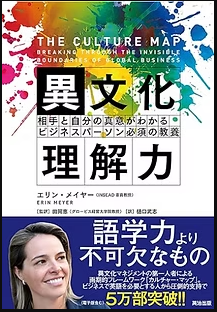
It comes from Erin Meyer, a professor at INSEAD and the author of The Culture Map.
*********
When we say “Americans,” we have to remember that the United States is home to people from many different cultural backgrounds.
In fact, one of my clients once told me that they worked with Israelis, Iranians, and Indians—and joked about how they seemed to be surrounded by people from countries beginning with the letter “I”!
They said that each group could be very different in the way people think, react, and communicate.
So where exactly do these cultural differences appear? Here are eight dimensions we can use to understand them:
- Communicating: High-context or low-context? (We Japanese tend to be extremely high-context.)
- Evaluating: Is negative feedback given directly or indirectly? (Japanese people generally tend to be indirect—although there are certainly exceptions, including managers who publicly point out people’s shortcomings in ways that can feel intimidating or even like workplace harassment.)
- Persuading: Principles-first or applications-first? (Japanese communication tends to be more principles-first, while Americans tend to be more applications-first.)
- Leading: Egalitarian or hierarchical? (Japanese workplaces still tend to be relatively hierarchical.)
- Deciding: Consensual or top-down? (Japan, of course, tends to be consensus-oriented.)
- Trusting: Task-based or relationship-based? (Japan, China, and many other Asian cultures tend to place greater emphasis on relationship-based trust.)
- Disagreeing: Confrontational or avoids confrontation? (Japanese people generally tend to dislike open confrontation.)
- Scheduling: Linear-time or flexible-time? (Japan tends to be very linear when it comes to time. In the Middle East, for example, attitudes toward scheduling can be quite different.)
Now, think about the people in your own workplace.
For each of these eight dimensions, where would you place them along the spectrum?
And instead of comparing everyone with Japanese culture, try comparing two other cultures.
For example, imagine a workplace with Indian and Israeli employees. On which dimensions might the greatest differences appear? Where might misunderstandings or friction be most likely?
Perhaps dimensions 1, 2, 3, 4, and 7 could reveal some particularly interesting differences.
And if you are their manager, how would you bridge those differences?
It’s not an easy question!
If you find this topic interesting, I highly recommend picking up a copy of The Culture Map.
I’m planning to incorporate some of these ideas into an upcoming cross-cultural communication training program myself!
Until next time!